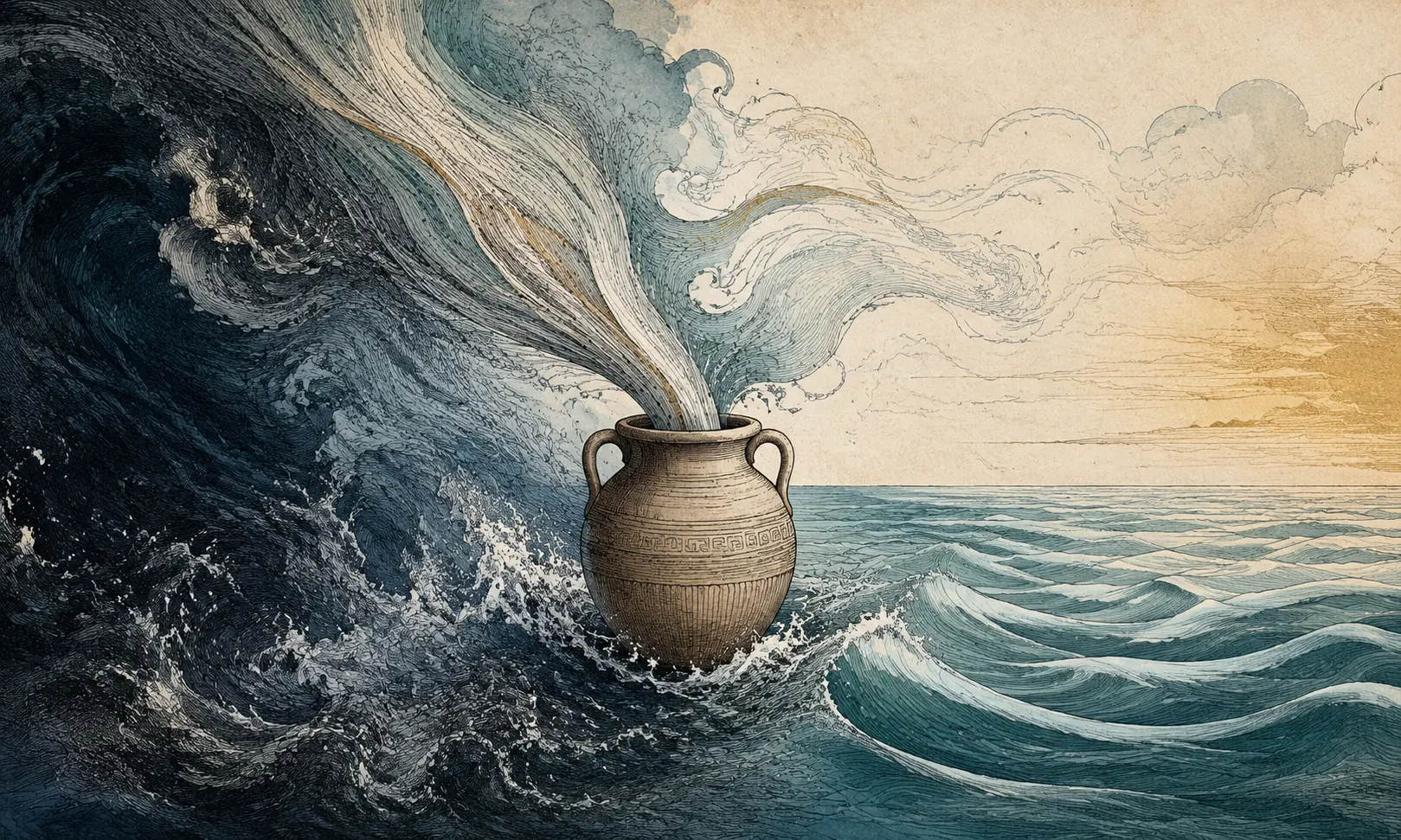
In the ancient Near East, the concept of primordial chaos was often personified as the vast, untamed waters from which the world emerged. Modern scholars, notably Robert R. Stieglitz, have drawn connections between ancient chaotic figures and the Akkadian Tiamat, the chaotic sea goddess of Mesopotamian myth, highlighting a shared cultural conception of the deep as both lifegiving and potentially destructive. This conceptual lineage extends to the Hebrew Bible, where the word tehom in Genesis 1:2 describes the “deep” over which God’s spirit hovers. Genesis 1:2: “Now the earth was formless and empty, darkness was over the surface of the deep, and the Spirit of God was hovering over the waters.” Linguistic and comparative studies suggest that tehom is cognate with Tiamat and other Northwest Semitic terms for primordial waters. By situating the Genesis account within this framework, the biblical narrative portrays God’s creative act as the deliberate subduing of chaos, transforming the formless deep into an ordered, habitable world. If we can conceive Genesis as a construct to beat chaos through a lens of IPO systems (Input, Process, Output), we can break down the arrangement into three parts. God was hovering over the chaotic waters (input). Then we see that something happened to make the waters submit (output); hence, Genesis 1:6: Genesis 1:6: “And God said, ‘Let there be a vault between the waters to separate water from water.’” There seem to be only two states: the waters of the deep before submission, and afterwards, where the waters have substance and form. The process step appears missing, but it can be found in God’s nature. When any entity comes up against the Spirit of God, it must submit; an instantaneous process takes place, hence the lack of need to explain it in Genesis explicitly. He did not destroy the waters of the deep; he used them to build his kingdom. Similarly, we too are to use chaos, when placed under submission through the Lord’s power, to help expand His domain. Chaos in this respect is untamed energy, not a demi-god or spirit opposed to God, but something that exists opposite to structure. Consider trees: when blown upon by winds, the wind does not destroy them but enhances their strength and tolerance, so that when a large storm comes, they will be more resistant to breaking. Chaos, if thought about as wind, is merely something used to create more strength. A human is much like the earth was in the sense of a Divine IPO system. When we face chaos, we can ask for the same power to come over us as was done in Genesis. We must allow chaos to expose where we are weak in the flesh, allow God to see the exposed part in his light, and then separate the water of chaos from our flesh and bring the waters of submission into His eternal peace and structure. This is a Divine IPO system: God as our input, the process as exposing and separating flesh from soul, and an output of peace and goodness, also described as eudaimonia, a Greek word meaning human flourishing through a life of purpose, virtue, and fulfillment. To subdue chaos is not to annihilate it. As we see in Genesis, God does not destroy the waters of the deep but rather separates and repurposes them. Chaos is allowed to exist, but it is placed within boundaries that make life possible. Absolute disorder produces anxiety and collapse, while absolute rigidity suffocates growth. Flourishing emerges only when structure and freedom coexist in tension.
Structure relieves cognitive strain by reducing unnecessary decisionmaking, freeing mental resources for higher-order thought. When life lacks structure, individuals are forced into constant reactive states, pursuing quicker gratification rather than intentional action. Structure introduces intentionality, replacing reactive behavior with conscious engagement. Far from suppressing autonomy, structure enables it by establishing predictable rhythms that stabilize mood, regulate stress, and orient attention toward meaningful pursuits. Structure is not the enemy of freedom; it is the condition that makes freedom livable. Chaos is not inherently destructive; it becomes destructive only when it lacks form. Together, structure and chaos, order and freedom, input and process, converge to produce a life that is not merely stable, but meaningful. The divine IPO system captures not only a small aspect of the Genesis creation narrative, but the ongoing human goal: to allow the Spirit to shape chaos into form, and thus make form into flourishing in our souls.